It's the question every planner asks before booking a live-printing station, and it's the right one: how many shirts can you actually print per hour? The honest answer is a number you can plan around. A single manual press prints up to 60 shirts an hour, and our standard rig — two presses and two printers — clears 100 or more per hour at full tilt, roughly one finished shirt every two minutes per press. From there it's just arithmetic: match the rig to your guest count and your event hours, and you'll have a shirt for everyone who wants one.
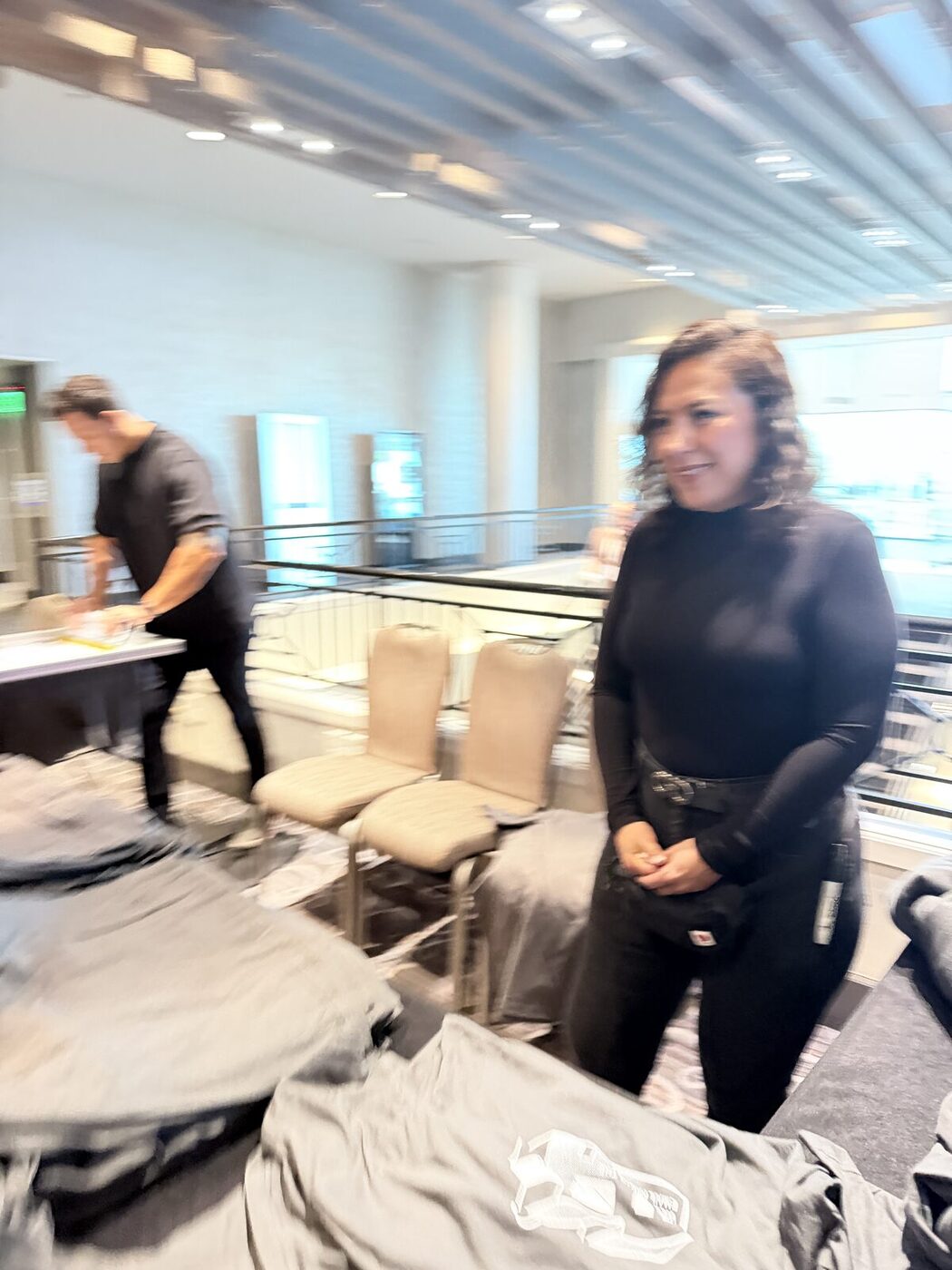
Below is how the math actually works at an LA event, what speeds it up or slows it down, and how to size your station so the line moves and nobody walks away empty-handed.
The baseline: 60 per press, 100+ per rig
Every number starts at the press. One manual press, staffed by one printer, prints up to 60 shirts an hour. That's the ceiling for a clean, single-location design pulled at a steady pace — about two minutes from "what size?" to a folded shirt in someone's hands.
Our standard setup is two presses and two printers in roughly a 10x10-foot footprint. Run both at once and you're at 100-plus finished shirts every hour, sustained, for as long as the event runs. That's the figure to plan around for most LA conferences, launches, and sponsor activations. Each print is made on demand in the guest's size — sizes XS through 4XL stay on hand — so you're never printing inventory nobody asked for.
Want it faster? Add a station. A bigger rig with three or four presses scales the same way: each press is another 60 shirts an hour on the board.
What changes the rate: colors and second locations
Sixty per press assumes a straightforward design. Complexity is the main thing that moves the number, and it moves predictably.
- Number of ink colors. On a screen press, each color is its own screen and its own pass. A bold one- or two-color logo flies. A four-color design takes more handling per shirt, so the realistic per-press rate eases down from the 60 ceiling.
- A second print location. Adding a back or a sleeve hit means a second press cycle per shirt. Two locations roughly doubles the work per garment, so plan for it in your headcount math up front.
- Art changes mid-event. Swapping designs on a screen press means re-screening. If your event needs frequent art changes or per-guest personalization, that's where the method matters — see below.
None of this is a problem. It's just input. Tell us the design before the event and we size the crew to hit your throughput target with the art you actually want.
Rule of thumb: a clean one- or two-color front print runs near 60 per press per hour. A detailed multi-color design or a front-and-back print runs slower per shirt — so we add a station or an hour rather than letting the line back up.
DTF vs screen: two ways to hit volume
Screen printing gets the spotlight, but it's only one of the methods we run live — and at a fast event it often isn't the lead. The throughput trade-off between live screen printing and live DTF is worth understanding.
Live screen printing is the classic: real presses, real ink, pulled in front of guests. It's fastest and most economical when the art is one or two strong colors at high volume — a single logo, a big crowd, a simple board. That's where it earns its place.
Live DTF presses full-color, photo-real transfers on site with no screens and no color limits. Because there's no per-color setup and designs swap instantly, DTF keeps a steady pace on complex, multi-color, or per-guest art that would slow a screen press down. For gradients, photos, sponsor logos sharing one booth, or fast art changes, DTF is usually the faster real-world choice. Our DTF vs screen printing guide breaks down which to pick for your art.
Most busy booths run both side by side — one method for the high-volume staple, one for the detailed or personalized pieces — so the line never stalls waiting on a screen.
Worked example: 250 guests, 3-hour reception
Take a typical LA evening reception — 250 guests, a three-hour window. Not everyone wants a shirt; realistically 60–75% do, call it 160 to 190 shirts over the night.
Our standard two-press rig prints 100-plus an hour, so it clears that volume in under two hours of actual printing. Spread across a three-hour reception, you're never close to maxed out — the press is keeping pace with the line as guests drift over between drinks and conversation, with margin to spare for a back print or a second design. One standard station comfortably covers this event.
Worked example: 500 guests, full expo day
Now scale up to a trade-show booth — 500 badged attendees across an eight-hour expo day at a venue like the Los Angeles Convention Center. Demand is steadier and longer here, and floor traffic comes in waves around session breaks.
At 100-plus shirts an hour, the standard two-press rig handles roughly 800 shirts across an eight-hour day — comfortably more than 500 guests will ever claim. The real question on a show floor isn't total capacity; it's surviving the rush peaks without a 30-minute line. For a major expo day we'll often stage a larger rig or a DTF station alongside screen so the booth never has a dead moment and never has a runaway line. For the full show-floor playbook, see live printing at the LA Convention Center.
Managing the line so you never run out
Capacity on paper is one thing; a smooth line is another. A few things keep an event flowing:
- Size the rig to the peak, not the average. If 200 of your 500 guests hit the booth in one 90-minute window, plan for that surge — that's when a second press or a DTF station earns its keep.
- Take size and design at the front of the line. Capturing "size and which design" before guests reach the press keeps the printers pulling instead of asking, which protects that two-minute-per-shirt pace.
- Stage the blanks. Sizes XS–4XL stay on hand and pre-sorted, so a printer never stops to dig for a 2XL.
- Add an hour before you add stress. Often the cleanest fix for a big crowd is simply one more hour of printing rather than a frantic pace — and pricing scales by hour, so it's easy to plan.
What "full tilt" really means
Full tilt isn't a sprint that burns out by hour two. It's both presses running steadily, a finished shirt coming off about every two minutes per press, 100-plus an hour, held for the length of the event without quality slipping. We staged the gear to run all day; the crew prints all day. The cap on your event isn't the press's endurance — it's how many stations and hours you book against your guest count.
So size it on purpose. Tell us your guest count, your event hours, and your design, and we'll spec the number of presses, printers, and hours that hits your throughput with room to spare. The big cost levers — guest count, printing hours, garment choice, and number of stations — are the same levers that set your capacity, so the quote and the plan come together. See what live printing costs in LA, then check how pricing works for the full picture.
Send your venue, date, headcount, and event hours and we'll itemize the crew, presses, garments, setup, and every print as one clear quote — and size the rig so you have enough.