Most teams planning an LA activation arrive with the same question: should the booth run live DTF or live screen printing? It's the right question, and the honest answer is that they solve different problems. Screen printing is the classic — bold, tactile, unbeatable on cost when the art is simple and the volume is high. Live DTF is the full-color workhorse — photo-real, no color limits, and quick to swap when sponsors and logos change by the hour. The trick at a conference, launch, or sponsor lounge is matching the method to your art, your fabric, and your pace on the floor. Here's how each one actually runs, and how to choose.
We run both at events across the Los Angeles metro — DTLA, Century City, El Segundo, Glendale, Long Beach, and Pasadena — so this isn't a sales pitch for one over the other. It's how we'd size a booth if you handed us your run-of-show.
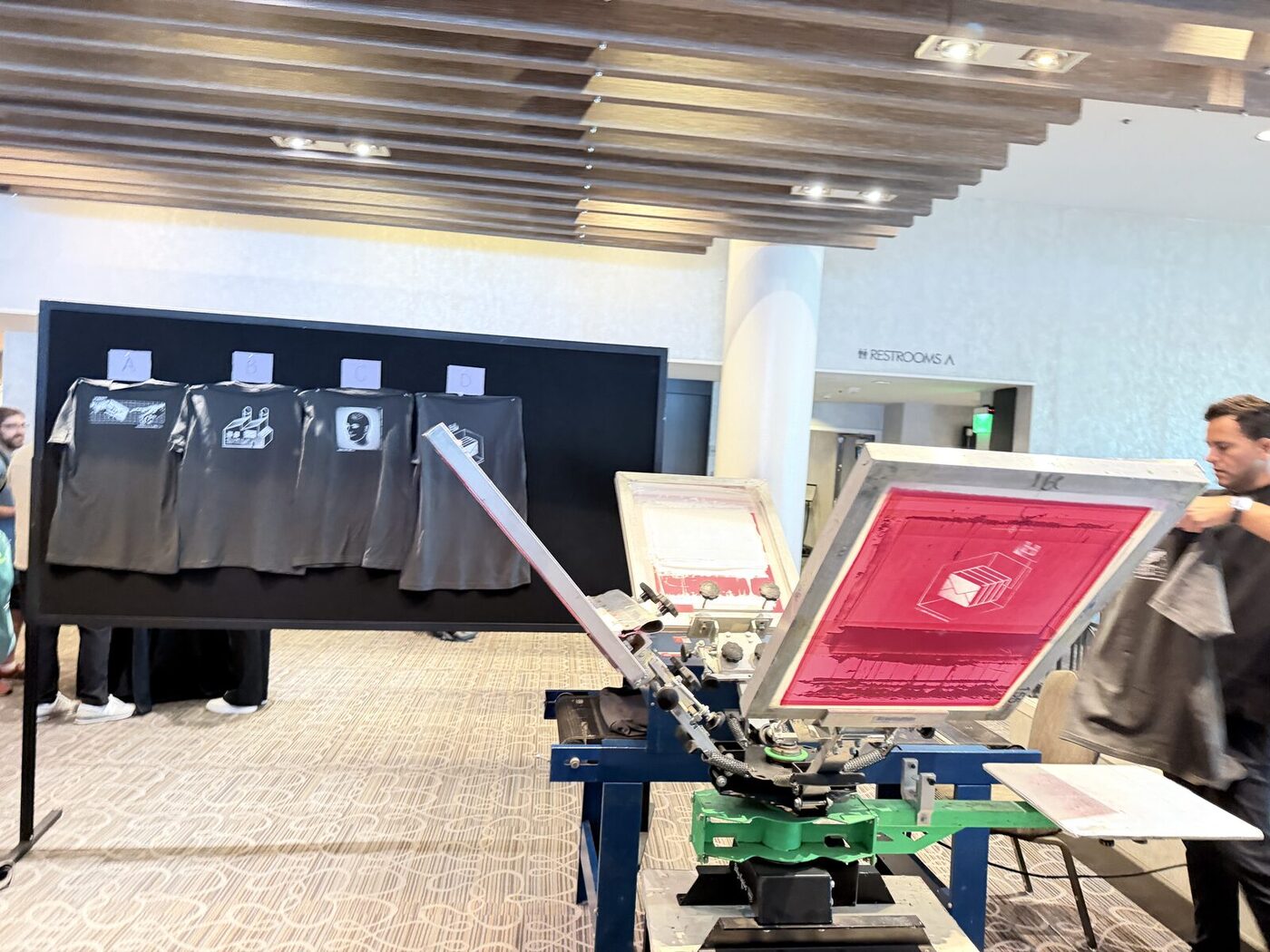
How each method works, live on the floor
Live screen printing is the real thing — physical screens, real ink, a squeegee pulled across the platen in front of guests. The crew burns a screen per color ahead of time, then prints, flash-cures, and folds on site. It's mechanical and satisfying to watch: the press thunks, the shirt comes off, the line moves. Because each color needs its own screen and registration, screen printing rewards a strong one- or two-color logo and a committed design that won't change mid-event.
Live DTF (direct-to-film) skips screens entirely. The artwork is printed full-color onto transfer film, and the crew heat-presses it onto the garment on demand. No registration, no per-color setup, no ink mixing. That means gradients, photographs, fine type, and multi-color sponsor logos all print the same way — and swapping to a different design is as fast as grabbing a different transfer. For booths where the art changes by the hour, that flexibility is the whole game.
Color, detail, and personalization
This is where the two methods separate most clearly. Screen printing is built for bold, flat color — a clean logo in one or two ink colors that pops and feels great on the shirt. Push it toward photo-real gradients or six-color art and the setup cost and complexity climb fast.
Live DTF has effectively no color ceiling. Full-color brand marks, product photography, gradients, and small text all reproduce cleanly off a single transfer. It's also the method of choice for per-guest personalization — a name, a title, a team, a session number pressed onto each shirt as the guest watches. For multi-logo and sponsor events, where one booth needs to honor four different brands across the day, DTF lets you swap art instantly instead of re-screening.
Speed and volume
On raw throughput, the two are closer than people expect, because both bottleneck at the press. Each of our manual presses prints up to 60 shirts an hour, and our standard rig is two presses plus two printers — so a busy booth clears 100-plus shirts an hour at full tilt, roughly two minutes per finished piece. That holds whether the station is screen or DTF.
Where they differ is setup and changeovers. Screen printing front-loads its work: screens are burned before the event, so once it's running it's fast and steady — ideal for one design, high volume, all day. DTF wins on flexibility: no screens to burn, and design changes cost you seconds, not a re-setup. If your booth prints one logo to a long line, screen printing hums. If it prints a rotating set of sponsor marks, DTF keeps the line moving without downtime.
Booth math: one press handles a steady single-logo line; a two-press rig keeps a busy conference booth moving all day. To size your station to expected floor traffic, see how many shirts we print per hour.
Cost drivers
Neither method has a flat sticker price, because a live booth is a staffed production, not a per-shirt order. The big levers are the same for both: guest count, number of printing hours, garment choice, and number of stations. Most LA events land between $5K and $15K all-in, with one number covering crew, presses, garments, setup and teardown, and every print — and travel is $0 across LA County.
That said, the methods tilt the math differently. Screen printing carries a small upfront cost to burn screens, but at high volume on a simple design it delivers the lowest per-piece cost — the more shirts you pull off one screen, the cheaper each one gets. DTF has no screen setup, so it's efficient at lower volumes and across many designs, but it doesn't get dramatically cheaper per shirt as quantity climbs the way a single-screen run does. Rule of thumb: high volume, one design favors screen; mixed art and personalization favors DTF. Full breakdown in our guide on what live printing costs in LA.
Garment and fabric suitability
Both methods press onto the same blanks we keep on hand — sizes XS through 4XL, printed on demand so guests get their actual size. The difference is in how the print sits on the fabric.
- Screen printing lays ink directly into the weave for that classic, broken-in tactile feel. It's the look people associate with a great event tee — soft hand on cotton, durable, no edge around the print.
- Live DTF sits as a thin, flexible full-color layer pressed onto the garment, which is exactly what lets it carry photo detail and gradients. It's versatile across cotton, blends, and more technical fabrics, and holds fine detail that ink-on-weave can't.
If your giveaway is a premium cotton tee with a simple mark, screen printing feels the part. If it's a full-color design — or a poly-blend, a performance shirt, or a tote — DTF is the safer match.
A decision rule of thumb
Strip it down and the call is usually quick:
- Choose live screen printing when the art is one or two bold colors, the volume is high, the design is locked, and you want the classic tactile finish at the lowest per-piece cost.
- Choose live screen printing's counterpart, live DTF, when the art is full-color, photo-real, or gradient-heavy; when you need per-guest personalization; or when sponsor and logo art changes through the day.
When in doubt, lean DTF — it covers more art and fabric scenarios with no setup penalty. Lean screen when you've got one strong logo and a long line to feed.
When to run both
At a lot of LA conferences and product launches, the answer isn't either/or — it's both, side by side. A two-station booth might run screen printing for the hero event tee everyone wants, while a live DTF station handles the rotating sponsor logos, full-color product art, and personalized pieces for VIPs. That keeps two lines moving at once, doubles throughput, and means no attendee waits while a single press changes gears. For sponsor lounges and multi-brand activations especially, the dual setup is usually the strongest play. Brands like Dickies have run live printing at their events, and the floor-level lesson is consistent: the booth that never has a dead moment is the one people walk the show to find.
The fastest way to a real recommendation is to send your venue, date, expected headcount, and your art. We'll tell you which method — or which mix — fits your floor, and itemize the crew, presses, garments, setup, and every print as one clear quote within 24 hours.